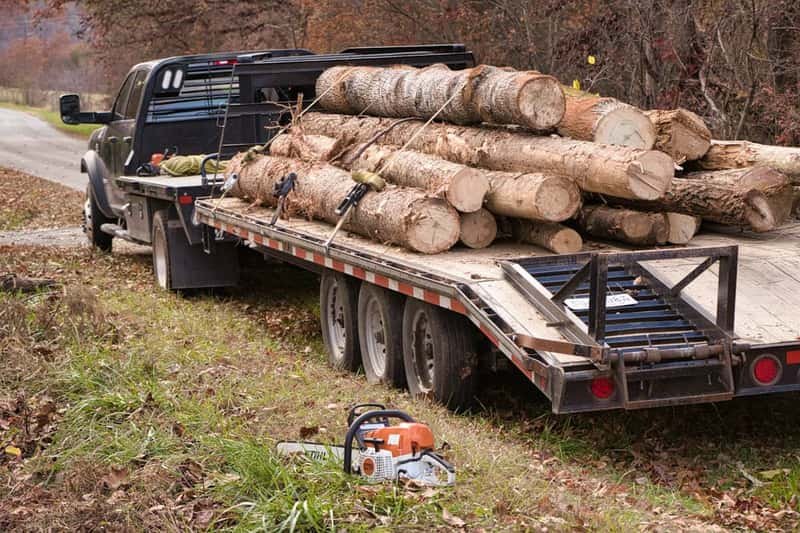
Hotshot estimator: will it fit, how far, how long?
Two ZIP codes and the freight. You get estimated road miles, driving days, whether it rides on a non-CDL or CDL hotshot, permit flags, the minimum tie-down count and what the truck burns in diesel. No email, no account.
How the estimate is built
Four steps, each from a public source. Miles: the center of each ZIP code comes from the Census Bureau's ZCTA Gazetteer file; the straight-line distance between the two centers is multiplied by a road factor of 1.2, the usual allowance for the way highways bend around terrain, and rounded to the nearest 10 miles. Days: road miles divided by a 450-mile planning day, which is what 49 CFR 395.3's 11 driving hours leave after loading, fuel and traffic. Fit: the pieces are laid across a 102-inch-wide, 40-foot deck, the stack is checked against the common 13 ft 6 in height limit, and the total weight is compared with the non-CDL and CDL hotshot ceilings. Securement: the minimum tie-down count from 49 CFR 393.110, with the four-tie-down floor of 393.130 for machinery at 10,000 lb or more.
Worked example (illustrative)
Two crated electric motors, 72 × 48 × 48 in and 1,600 lb each, from ZIP 23224 (Richmond, VA) to ZIP 28208 (Charlotte, NC), flexible timing, no tarp, forklifts at both ends.
| Straight line between the two ZIP centers | 247 mi |
| Road miles: 247 × 1.2 = 296, rounded | about 300 mi |
| Transit: 300 ÷ 450, rounded up | 1 driving day |
| Weight: 2 × 1,600 lb = 3,200 lb | Non-CDL hotshot (under 8,000 lb) |
| Deck: two 48 in wide crates side by side on 102 in, 72 in of deck used | Fits, legal size, no permit |
| Tie-downs: each crate is 5–10 ft long, so two each (49 CFR 393.110) | 4 minimum; combined WLL at least 1,600 lb |
| Diesel: 300 ÷ 9 mpg = 33.3 gal × $6.276 (EIA, week of 2026-10-19) | about $209 of fuel before the driver earns anything |
| Price range | Not shown. For context only: FreightRun's 2026 gooseneck benchmark of $2.00–$3.00 per mile would bracket this run at $600–$900 before accessorials |
The fit rules the tool checks
| Check | Rule used | Where it comes from |
|---|---|---|
| Width | Over 102 in needs an oversize permit | 23 CFR 658.15 (FHWA federal size limits) |
| Height | No federal limit; most states cap overall height at 13 ft 6 in. On a deck about 36 in off the ground that leaves about 126 in of load | FHWA size overview; state permit rules |
| Length | A single piece longer than the 40 ft deck, or pieces that need more than 40 ft of deck, go to a 48–53 ft flatbed | Deck dimensions; overhang rules vary by state |
| Weight, non-CDL hotshot | Total freight up to 8,000 lb | 49 CFR 383.5 (26,001 lb GCWR line) and typical truck-plus-trailer weights; see the hotshot page |
| Weight, CDL hotshot | 8,001–16,000 lb | Typical gooseneck class ceiling (FreightRun 2026 lists goosenecks to 16,500 lb) |
| Weight, flatbed | 16,001–48,000 lb; above that, specialized | 80,000 lb federal gross limit less tractor and trailer |
Minimum tie-downs (49 CFR 393.110)
| Piece | Minimum tie-downs |
|---|---|
| 5 ft or shorter and 1,100 lb or less | 1 |
| 5 ft or shorter and over 1,100 lb | 2 |
| Over 5 ft up to 10 ft, any weight | 2 |
| Over 10 ft | 2 for the first 10 ft, plus 1 for each additional 10 ft or part of it |
| Vehicle or machinery of 10,000 lb or more | At least 4, at the front and rear or at designed mounting points (49 CFR 393.130) |
These counts apply to pieces that are not blocked against forward movement; the combined working load limit of all tie-downs must be at least half the cargo weight (49 CFR 393.106). The driver, not the shipper, is responsible for securement, but knowing the count tells you whether the quote should include chains and binders or straps, and how long loading will take.
What this tool does not do
- No load-board data. It never reads DAT, Truckstop or any rate index. The tool shows no price while registration is pending.
- No accessorials. Detention, layover, tarping, permits, escorts and driver assist are separate lines. Our accessorial glossary shows which ones a move like yours tends to attract.
- No booking. Averstone Logistics does not arrange shipments until its registration is active. The button under the result sends your details to our interest form so we can contact you the day we open.
- No routing. Road miles are an estimate from the straight line; a carrier's routing software will differ, usually by a few percent.
Once you have the miles, see what published sources say that distance costs for specific freight: the cost to ship a skid steer, mini excavator, generator and motors and switchgear guides, or hotshot rates explained for how a per-mile price is built.
Estimator questions
Is this estimate an offer or a quote?
No. It is a planning estimate built in your browser from public data and your inputs. Averstone Logistics LLC is preparing its FMCSA property-broker registration and does not arrange or quote shipments until it is active. Use the result to decide what to ask for, then tell us about the freight and we will contact you the day we open.
How does the tool estimate the miles?
It looks up the population-weighted center of each ZIP code from the U.S. Census Bureau's 2023 ZCTA Gazetteer file, measures the straight-line distance between the two points, and multiplies by a road factor (1.2 unless our admin sets another value). Real routing differs, more so around water, mountains and large cities, and the error is larger in percentage terms on short runs. Treat the result as "about", not as a mileage audit.
Why is there no price in my result?
Averstone Logistics LLC is preparing its FMCSA property-broker registration and does not arrange, quote or price shipments until it is active, so the tool shows no price. We never use DAT, Truckstop or other load-board figures. The hotshot rates guide reports 2026 ranges from named, dated publications so you can bracket the number yourself.
How are the transit days figured?
Under 49 CFR 395.3 a property-carrying driver may drive 11 hours inside a 14-hour window. After loading, fuel and traffic, a realistic planning day is about 450 road miles, so the tool divides the road miles by 450 and rounds up. One driving day means delivery the day of pickup or the next morning; two means the day after pickup, and so on. Team driving and relays are not assumed.
What is the weight limit for a non-CDL hotshot?
There is no single figure. Under 49 CFR 383.5 a combination needs a Class A CDL once its gross combination weight rating reaches 26,001 lb with a trailer rated over 10,000 lb, so a non-CDL hotshot keeps truck plus trailer at 26,000 lb or less. After the truck and empty trailer, roughly 8,000–10,000 lb is left for freight. The tool uses 8,000 lb as the non-CDL ceiling and 16,000 lb as a typical CDL hotshot ceiling, and routes anything heavier to a full flatbed or step-deck.
When does a hotshot load need a permit?
Width over 102 inches needs an oversize permit on the National Network (23 CFR 658.15). There is no federal height limit, but most states cap overall height at 13 ft 6 in, which leaves roughly 126 inches of load on a deck that rides about 36 inches off the ground; taller freight needs a lower deck or an over-height permit. Long pieces that overhang the deck are governed state by state. The tool flags width, height and deck length; permits and escorts add cost and usually a day.
How many tie-downs does my freight need?
49 CFR 393.110 sets the minimum: one tie-down for a piece 5 ft or shorter that weighs 1,100 lb or less; two for a piece 5 ft or shorter that is heavier, or any piece between 5 and 10 ft; and for pieces over 10 ft, two for the first 10 ft plus one for every additional 10 ft or part of it. Machinery weighing 10,000 lb or more needs at least four tie-downs under 49 CFR 393.130. The combined working load limit must also be at least half the cargo weight (49 CFR 393.106). The tool reports the regulatory minimum; the driver may add more.
Do you store my ZIP codes or load details?
The estimate runs entirely in your browser: the ZIP centroid table is downloaded to your device and nothing is sent to us when you press Estimate. If you start typing a city name instead of a ZIP, those letters go to the free Photon address-suggestion service (OpenStreetMap data) to suggest matches. Our analytics receives only bucketed values such as a distance band and the equipment verdict, never ZIP codes or free text. Each run, including the ZIP codes and load details, is also kept in this browser's local storage (the ten most recent runs) so it appears on My Estimates, where you can delete it, or you can clear this site's data in your browser; it reaches us only if you copy it into our form and submit that form. Your latest inputs are also held in this tab's session storage to pre-fill our form, and reach us only if you submit that form.
Open-Deck Load Prep Sheet
Dimensions, weights, securement and unloading: fill it out once so any carrier can price flatbed or hotshot freight accurately.
Know the miles and the fit? Tell us about the move.
Send the lane, dates and freight details; we contact you the day we open.
We answer every message within 30 minutes, Mon–Fri 8am–5pm ET, and within 6–12 hours at other times.