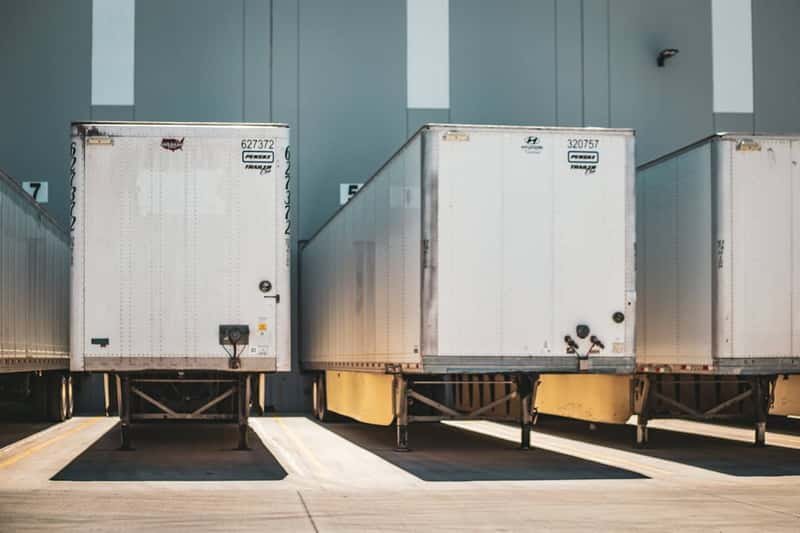
What ships in a dry van
The enclosed 53-foot dry van is the workhorse of manufacturing freight. If your product is boxed, palletized, and doesn't need temperature control, it almost certainly moves in a van. Typical dry van loads include:
- Consumer packaged goods — household products, personal care, cleaning supplies, school and office supplies.
- Shelf-stable food and beverage — snacks, canned goods, bottled water, pet food and dry ingredients.
- Apparel, electronics and tires — floor-loaded or palletized, often high-value.
- Packaging and raw materials — empty boxes, film, resin and components headed back to a plant.
Where dry van freight goes wrong — and how to plan around it
Most dry van problems don't happen on the highway. They happen at the dock. A truck arrives outside its window, the PO number on the bill of lading doesn't match, the pallets overhang, or the receiver wants a lumper and nobody budgeted for it. Each of those turns into a refused load, a re-delivery, or a chargeback.
What to confirm before pickup
- Pallet count, footprint and whether the freight can be stacked
- Total weight and how it's distributed, so the trailer scales legally
- Live load or drop trailer, and the shipping hours at your dock
- PO numbers, delivery reference numbers and any receiver-specific labeling
- Appointment owner and window at delivery
Full truckload vs. partial
A full truckload means your freight has the whole van — no stops, no transfers, no other shipper's pallets. It's usually the cheaper choice once an order passes roughly 12–14 pallets (about 28 linear feet) or 15,000–20,000 lbs, and the van itself holds about 26 standard pallets single-stacked (30 turned, and about 52 two high if the freight stacks and weight allows), so a full truck is often cheaper per pallet than people expect. Between about 12 and 28 linear feet (roughly 6 to 14 pallets) a shipment is volume-partial territory, and under 12 linear feet (roughly 1 to 6 pallets) it is standard LTL. The pallet count and weight decide which makes more sense, so include both when you tell us about your freight; the pallet and linear-feet calculator applies the same thresholds.
Retail distribution center deliveries
Big-box retail DCs run tight receiving schedules and enforce vendor compliance rules — appointment windows, pallet specs, labeling, and on-time-in-full targets that can lead to fines when missed. Rules differ by retailer and are updated regularly, so the right approach is to work from the receiver's current routing guide for each shipment rather than from assumptions. Our Retail DC Delivery Guide covers the basics every vendor should have ready.
What a dry van quote depends on
| Detail | Why it matters |
|---|---|
| Pickup & delivery ZIPs | Sets the lane and the mileage |
| Ready date & required delivery date | Determines whether standard transit works or the load needs a team or expedite |
| Pallet count & footprint | Decides whether it's a full van or a partial |
| Total weight | Legal weight limits often cap a van before space does |
| Stackable or not | Changes how many positions the load uses |
| Appointment requirements | Drives scheduling and detention exposure |
Don't have every answer? Send what you know and we'll ask for the rest when we contact you. Tell us about your freight.