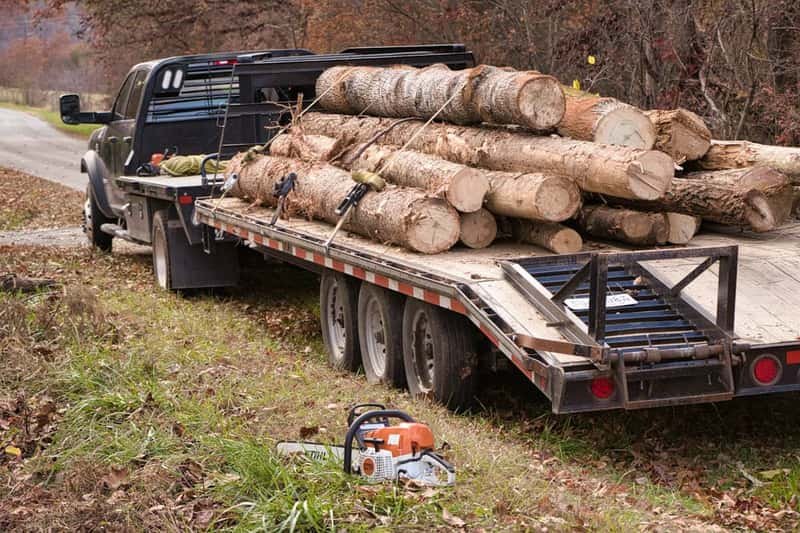
A skid steer is one of the simpler machines to ship for a simple reason: it fits on a trailer a pickup can pull. That also makes its shipping price unusually easy to pin down, because the move is one machine, one deck, one driver, and the variables are few. This guide collects the 2026 price ranges that public pages actually publish, says where each number comes from and whether it is a shipper price or carrier pay, and explains the mechanics that decide which end of the range you land on.
What you are shipping: weight and footprint by class
Everything about the price starts with two numbers: how much the machine weighs with fluids and attachments, and how big its footprint is with the bucket on. Manufacturers publish both. The weight decides the trailer class and, at 10,000 lb, which securement rule applies; the footprint decides whether the move is legal-size (it almost always is) and how much deck is left for anything else.
| Class | Example (manufacturer spec, opened Oct 2026) | Operating weight | Rated operating capacity | Footprint with bucket |
|---|---|---|---|---|
| Mini | Bobcat S70 (Bobcat U.S. spec page) | 2,892 lb | 760 lb | 97.3 in long with bucket × 35.5 in overall width × 71.4 in overall height |
| Small frame | New Holland L316 / L318 | 5,370 lb / 6,230 lb | 1,600 lb / 1,800 lb | Not listed on the model pages |
| Mid frame | New Holland L328; Bobcat S650 dimensions from Ritchie Bros.' RitchieSpecs database | 7,895 lb (L328). Beardown Logistics (Feb 2026) puts a Bobcat S650 near 8,300 lb. | 2,800 lb (L328) | S650: 11.4 ft long with bucket × 6 ft over the tires × 6.78 ft to the cab top (≈ 137 × 72 × 81 in) |
| Large frame | New Holland L334 | 9,100 lb | 3,400 lb | Not listed on the model page; expect the S650 footprint plus a few inches |
Three things to take from the table. First, a mid-frame skid steer is about 6 ft wide and under 7 ft tall, so it sits well inside the 102-inch federal width limit and under every state height limit (most run from 13 ft 6 in to 14 ft, per FHWA's Size Regulations report). Second, the brochure weight is not the shipping weight: Beardown's guide advises adding 500–1,000 lb to the manual figure for fuel, hydraulic fluid and the tire or track package, and every extra attachment counts on top. Third, large frames and compact track loaders cross 10,000 lb with attachments (Beardown cites a Cat 299D3 XE track loader at roughly 11,700 lb), which is both the 49 CFR 393.130 threshold and roughly the point where a non-CDL hotshot runs out of payload.
Why a hotshot is the usual fit, and when you need a full flatbed
A hotshot is a one-ton dually pulling a 30- to 40-foot gooseneck deck. C.H. Robinson's flatbed group (April 6, 2026) describes it as suited to loads under about 10,000 lb and 40 ft or shorter, with a ceiling near 17,000 lb, and points to jobsites, rural addresses and locations without dock access as where it earns its keep. That is a description of a skid steer move. One mid-frame machine with a bucket uses about 12 feet of a 40-foot deck and roughly 70% or more of a non-CDL hotshot's payload, which Beardown Logistics (Feb 2026) puts at roughly 9,000–11,000 lb (a CDL hotshot up to 16,500 lb).
A non-CDL hotshot stops being the answer when any of these is true:
- Two or more machines, or one machine plus pallets of attachments. Two mid-frames are about 15,800–16,600 lb before fluids and attachments, and past the 16,500 lb a CDL hotshot can carry (Beardown, Feb 2026) once fluids go in. A 48-foot flatbed carries about 48,000 lb (see the pallet and linear-feet calculator for deck presets).
- A large frame or track loader with attachments that lands over about 10,000 lb. A CDL hotshot can still take it; a non-CDL one usually cannot (Beardown puts non-CDL payload at roughly 9,000–11,000 lb, our hotshot page at roughly 8,000–10,000 lb), and Beardown's 1,200-mile example for an 11,700 lb track loader prices it on a heavy-duty CDL hotshot at $2,400–$3,000 or a lowboy at $3,600–$4,500 (Feb 2026, shipper-side).
- Non-running and no loader on site. A winch or a tilt deck solves most of these; a dead machine with no way to lift it points to a removable-gooseneck (RGN) trailer (A-1, Sept 2026), a lowboy type that Beardown's lowboy estimates (Feb 2026) put well above a hotshot.
- A tall attachment that must ride upright or a bucket wider than the deck. Either moves the load toward a step-deck or a permit, and at that point a hotshot's lower deck height is no longer the cheapest answer.
The hotshot vs. flatbed vs. dry van guide covers the general trade-offs; the rest of this page assumes a single legal-size machine, because that is what most skid steer moves are.
Cost to ship a skid steer by distance (2026)
These are the ranges the sources publish, grouped into the distance bands shippers actually ask about. Every figure is a shipper-side estimate unless marked carrier pay. Where a source publishes a per-mile rate rather than a total, the per-mile figure is shown and you multiply by your loaded miles. None of the figures is ours, and none is copied from DAT's rate tables, which DAT's terms do not allow us to republish.
| Distance | Published total ranges (source, date) | Per-mile context | What usually decides it |
|---|---|---|---|
| Under 200 mi | A-1 Auto Transport (Sept 2026): $300–$600 for runs under 200 mi in its overview, $700–$1,200 for short open-trailer hauls in its FAQ. HeavyDutyYard (Apr 2026): $600–$1,200 local for a 6,000–12,000 lb machine. | HeavyDutyYard (Apr 2026): $4.00–$5.00 per mile under 200 mi for RGN loads, shown for context only; on short runs the minimum charge, not a per-mile rate, sets a hotshot price. The dated hotshot minimums are in Hotshot rates explained. | The minimum charge. A truck still spends most of a day on a 90-mile move, so the per-mile math stops working. |
| 200–500 mi | Beardown (Feb 2026): a Bobcat S650 at about 8,300 lb over 400 mi, $800–$1,200 by hotshot or $1,400–$1,800 by lowboy; its FAQ gives $750–$1,500 hotshot and $1,200–$2,000 lowboy for 500 mi. | Beardown (Feb 2026): hotshot $1.50–$3.00 per mile. HeavyDutyYard (Apr 2026): $3.00–$4.50 per mile for the 200–500 mi band, RGN loads. | Deadhead. If the nearest empty truck is 120 miles away, that is about a quarter of the miles driven on a 350-mile load (120 of 470). |
| 500–1,000 mi | A-1 Auto Transport (Sept 2026): $1,500–$3,500 for a legal-size machine on an open trailer. HeavyDutyYard (Apr 2026): $1,500–$3,000 for a 6,000–12,000 lb skid steer or track loader on a flatbed. | HeavyDutyYard (Apr 2026): $2.00–$3.50 per mile, RGN loads. The carrier-pay bands, which are gross revenue per mile (what the broker pays the truck), are in Hotshot rates explained. | Whether the driver can deliver on day two. A receiver that closes early turns a two-day run into three. |
| 1,000–1,500 mi | HeavyDutyYard (Apr 2026): about $2,500 as a typical total for a 1,000-mile skid steer move. Beardown (Feb 2026): $2,400–$3,000 for an 11,700 lb track loader over 1,200 mi on a CDL hotshot, $3,600–$4,500 on a lowboy. | HeavyDutyYard (Apr 2026): $1.50–$3.00 per mile for 1,000–2,000 mi, RGN loads. | Fuel and the return load. Three driver days and a destination with little outbound freight both show up in the price. |
| 1,500+ mi | A-1 Auto Transport (Sept 2026): cross-country totals "often start near $3,000" and can exceed $5,000. HeavyDutyYard (Apr 2026): $3,000–$5,000 cross-country. | Beardown (Feb 2026): long hauls over 2,500 mi average $1.00–$1.50 per mile. HeavyDutyYard (Apr 2026): $1.00–$2.50 per mile over 2,000 mi, RGN loads. | Per-mile rate falls, total rises. Weather over the Plains and Rockies from November to March adds days, not dollars per mile. |
Two cautions. The low end of each range assumes a running, legal-size machine, ramps at both ends and a flexible pickup window; a quote well under the low end usually means something is different: a smaller machine, a partial (only realistic for a mini machine under about 4,000 lb; see hotshot partials), or a truck already headed your way. And a per-mile rate that looks cheap on a long haul is only cheap because the fixed costs are spread over more miles; it does not mean the truck is making less per day.
How the price moves by region
Region changes the price through three things: what diesel costs where the truck fuels, how dense the carrier network is, and whether the destination offers the driver a load home. EIA's weekly on-highway diesel survey is public domain and gives the first one directly; its regional table is printed once, with the week it is for, in Hotshot rates explained. For the other two, HeavyDutyYard's April 2026 guide publishes a regional table that assumes an oversize load on an RGN in the 500–1,000-mile bracket; a legal-size skid steer prices below those figures, so read that column for the ordering between regions, not as a skid steer number.
| Region | EIA diesel region | What tends to move the price (HeavyDutyYard, Apr 2026) | HeavyDutyYard per-mile, 500–1,000 mi, oversize RGN loads, shipper-side |
|---|---|---|---|
| Southeast (FL, GA, NC, SC) and Texas | Lower Atlantic; Gulf Coast (TX) | High construction demand keeps trucks busy; summer heat restrictions on some roads | $2.75–$3.75 |
| Midwest (IL, OH, IN, MI, MN) | Midwest | Flat terrain and a dense carrier network; the lowest average rates in its table | $2.00–$3.00 |
| Northeast (NY, PA, NJ, MA, CT) | Central Atlantic (NY, PA, NJ); New England (MA, CT) | Congestion, toll roads and tight pickup locations | $3.00–$4.00 |
| Mountain and Plains (CO, MT, WY, ND) | Rocky Mountain (CO, MT, WY); Midwest (ND) | Long distances between jobs and fewer backhauls, so the empty leg is priced in | $2.25–$3.25 |
| West (CA, OR, WA, NV, AZ) | West Coast; California | Mountain passes add time; California permit fees among the highest | $2.50–$3.50 |
The practical reading: a Charlotte-to-Atlanta move sits in EIA's Lower Atlantic region, the lowest regional diesel average in EIA's table for the week of October 19, 2026 ($5.740), so it prices on capacity, not fuel. A move that ends in Wyoming or rural Nevada prices on the empty miles home. For the week-to-week direction of the flatbed market, DAT Trendlines publishes a free weekly snapshot, and our Freight Market Pulse summarises what moved each week with dates.
Where these numbers come from, and how to use them
The ranges above are not a rate quote and were not built by us. We opened four public pages that publish skid steer or hotshot pricing in 2026 (A-1 Auto Transport, HeavyDutyYard, Beardown Logistics, O Trucking), kept only dated figures, and labelled each as what the shipper pays or what the carrier is paid. The two kinds differ: O Trucking's guide is written for operators and its $1.00–$2.00 per mile is gross truck revenue, the amount after any intermediary's margin, so a shipper's all-in price sits above it. A-1, HeavyDutyYard and Beardown write for shippers, and their figures are what a shipper could expect to see on an invoice. Where the pages disagree with each other (A-1's own overview and FAQ give different short-haul ranges) we show both rather than pick one.
To use the table: find your band, take the shipper-side range, then move within it using the list below. If three of the "raises" items apply, expect the top of the range or above it. If the machine is running, the dates are flexible and both ends have ramps or a loader, the bottom of the range is realistic. The pages that publish these figures are commercial sites (carriers, brokers, a dispatch resource and an equipment dealer) with an interest in the business, which is one more reason to describe the load precisely and compare like with like.
What raises or lowers the price
- Attachments. Each one adds weight and must be secured as its own article. A spare bucket and a set of forks can add several hundred pounds; take the weights from the attachment decals or spec sheets and declare them. An attachment wider than the deck (brush cutters, some snow blades) changes a legal move into a permitted one, and the published rate bands for oversize work sit above those for standard freight (see Hotshot rates explained).
- Non-running. Beardown (Feb 2026) lists $100–$500 for winch or forklift loading help. That is the cheap case; a machine that cannot be winched or lifted needs an RGN (A-1, Sept 2026) or a tilt deck; Beardown's lowboy estimates run about $600 above its hotshot estimates on a 400-mile move.
- Winch and tilt deck. Not every hotshot has a winch. Asking for one narrows the trucks available, which costs more than the winch fee does. Say up front whether the machine starts, moves under its own power and steers.
- Tarps. Rarely needed for a skid steer; new machines or ones with open cabs sometimes get one. Beardown (Feb 2026) lists tarping at $100–$200 plus the driver's time.
- Jobsite access. A gravel lot with room to turn a 60-foot combination and a loader on site is the base case. Gate hours, a residential street, a muddy site or no one present to drive the machine off all add time, and on a short run time is the whole price.
- Urgency and timing. Beardown (Feb 2026) says a flexible 3- to 5-day window lowers rates and recommends booking about two weeks ahead in peak season. HeavyDutyYard (Apr 2026) puts May–August rates 30–45% above the winter lows, with November–February the cheapest window. Expedited work prices above standard in every source that splits it out (see Hotshot rates explained).
- Fuel. EIA's survey puts the U.S. average on-highway diesel price at $6.276 per gallon for the week of October 19, 2026. On a hotshot that fuel bill is a large share of a short run's price (the worked example below shows how large), and it is why prices do not fall below a floor no matter how flexible you are.
- Season and weather. Winter over the Plains and the Rockies adds days to long runs.
Worked example (illustrative arithmetic on published ranges; not a price)
The load: one mid-frame skid steer, New Holland L328 class, 7,895 lb per the manufacturer spec, plus a 72-inch bucket and a full tank: call it 8,500 lb on the deck, running, 137 in long with the bucket, 72 in wide. Charlotte, NC to Nashville, TN, about 410 interstate miles. Ramps on the trailer, a yard at each end, pickup can float by two days.
The published ranges, applied: Beardown's hotshot rate of $1.50–$3.00 per mile (Feb 2026, shipper-side) multiplied by 410 loaded miles gives $615–$1,230; Beardown's own published example for an S650 over 400 miles is $800–$1,200. That is the multiplication of two cited ranges, not a price from Averstone Logistics, which does not quote shipments. The same page lists $100–$500 for loading help on a non-running machine and $100–$200 for a tarp.
Why a $500 price would be a warning sign: assume the truck deadheads 90 miles to the pickup, so 500 miles total, and assume 9 miles per gallon loaded (an assumption for illustration, not a measured figure). That is about 56 gallons; at EIA's $6.276 for the week of October 19, 2026, fuel alone is roughly $349, between 28% and 57% of the $615–$1,230 product above. On the carrier side, O Trucking's standard $1.00–$2.00 per mile (Oct 2026, carrier pay; applied here to loaded miles) is $410–$820 gross to the truck. A $500 price would leave the driver about $151 for a full working day after fuel.
| Line | Illustrative figure | Basis |
|---|---|---|
| Published rate times 410 loaded mi | $615–$1,230 | Beardown hotshot $1.50–$3.00/mi (Feb 2026); its 400-mi S650 example is $800–$1,200 |
| Fuel, 500 total mi at an assumed 9 mpg | ≈ $349 | EIA U.S. average $6.276/gal, week of October 19, 2026 |
| Non-running (if applicable) | + $100–$500 | Beardown, Feb 2026 |
| Tarp (if wanted) | + $100–$200 | Beardown, Feb 2026 |
| Transit | Same day or next morning | 49 CFR 395.3 hours of service; see the nationwide hotshot page |
Hotshot vs. flatbed vs. LTL for a skid steer
Hotshot
Fits: one legal-size machine inside the roughly 8,000–10,000 lb non-CDL planning range with its bucket, or a mini plus attachments. Payload is the limit: roughly 9,000–11,000 lb non-CDL, up to 16,500 lb CDL (Beardown, Feb 2026).
Price basis: per mile, $1.50–$3.00 shipper-side (Beardown, Feb 2026); the carrier-pay figures are in Hotshot rates explained. Minimums apply under about 200 mi.
Best when: jobsite delivery, no dock, a single machine, speed. The lower deck makes the loaded height a non-issue. See hotshot freight and nationwide transit bands.
Flatbed or step-deck
Fits: two or more machines, a large frame or track loader with a full attachment set, or a skid steer travelling with other freight. About 48,000 lb and 48–53 ft of deck.
Price basis: HeavyDutyYard (Apr 2026): flatbed $2.00–$3.00 per mile under 48,000 lb; step-deck, lowboy or RGN $2.50–$5.00+. Beardown (Feb 2026): step-deck $2.00–$2.50, lowboy $3.00–$5.00, both shipper-side.
Best when: the hotshot's payload is gone, the machine is dead with no loader on site (RGN), or you are moving a fleet. See flatbed and step-deck.
LTL
Fits: almost never a running machine. LTL carriers move pallets through terminals with forklifts; a skid steer is re-handled at every one.
Price basis: freight class, weight and density, with accessorials for anything a forklift cannot handle cleanly.
Best when: a mini machine (a Bobcat S70 is about 2,900 lb) is crated or bolted to a skid and the delivery has a dock. Otherwise a hotshot partial does the same job on an open deck without the terminals.
Loading, unloading and the tie-down rule
Ramps and forks
A running skid steer is driven on and off. Hotshot goosenecks carry their own ramps; a standard flatbed usually does not, so a flatbed delivery to a site without a dock or a loader needs ramps brought along or a second machine to lift. Confirm the ramp rating against the machine's weight, back the machine up the ramps with the heavy end uphill if the operator's manual says to, set the parking brake, and lower the bucket flat to the deck. A forklift can lift a dead mini machine with forks under the frame; anything mid-frame or larger that cannot move needs a winch, a tilt deck or an RGN.
Four chains, bucket down: 49 CFR 393.130
The federal securement rule for wheeled and tracked equipment is 49 CFR 393.130. It applies to equipment that individually weighs 4,536 kg (10,000 lb) or more, and lighter machines may be secured under it as well. The rule has three parts that matter for a skid steer:
- Accessory equipment such as hydraulic shovels must be completely lowered and secured to the vehicle (393.130(b)(1)). For a skid steer that means the bucket on the deck and the arm down.
- A minimum of four tiedowns, restraining the machine against lateral, forward, rearward and vertical movement (393.130(c)(1)).
- Each tiedown attached as close as practicable to the front and rear of the machine, or at mounting points designed for the purpose (393.130(c)(2)). Most skid steers have tie-down eyes or slots at all four corners; chain to those, not to the arm or the bucket.
Detached attachments are ordinary cargo under the general rules at 49 CFR 393.100–393.114, which means their own tiedowns with an aggregate working load limit of at least half the article's weight (393.106(d)). A loose spare bucket lying behind the machine is an easy securement miss on a skid steer load. Our motors and switchgear guide covers crating and center-of-gravity marking for the attachments that need it.
Where this applies
Hotshot and flatbed freight nationwide (lower 48). Dry van truckload across North Carolina, South Carolina, Georgia, Virginia, Florida, Alabama and Tennessee. USA only — no cross-border, no drayage, no rail, no temperature-controlled freight. A skid steer moving from a dealer, an auction yard or a jobsite anywhere in the lower 48 is in scope for the day our registration is active. Have one coming up? Tell us about your freight, including the weight with attachments, whether it runs and how flexible the dates are. We answer every message within 30 minutes, Mon–Fri 8am–5pm ET, and within 6–12 hours at other times.
Related guides and tools
Run your own ZIP codes in the hotshot estimator, see how the number is built in hotshot rates explained, and read how hotshot shipping works. For other equipment, see the cost to ship a mini excavator, cost to ship a generator and cost to ship motors and switchgear guides.