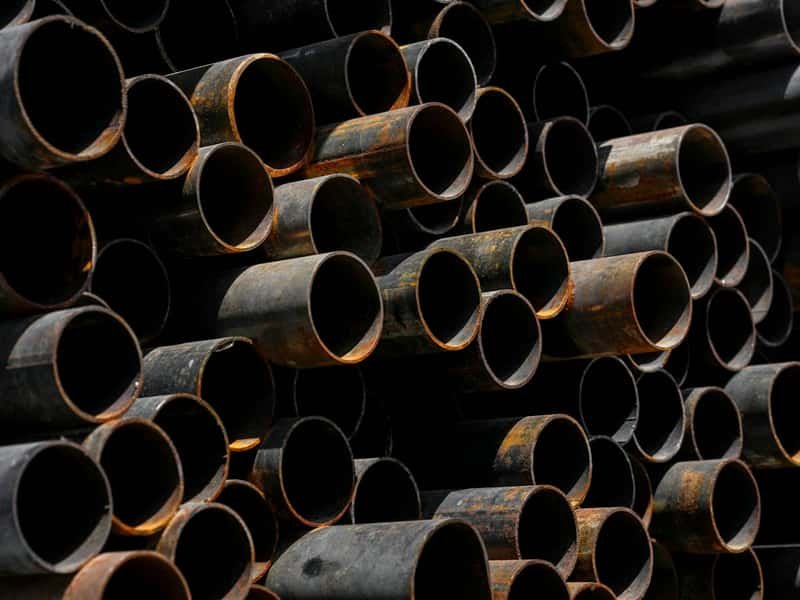
Metals freight is dense, long and unforgiving
Steel takes up very little room for its weight. A flatbed can be legally full with what looks like a short stack of plate or a few bundles of pipe. Pieces are often long, edges are sharp, and the load wants to slide forward under hard braking. That combination is why metals freight lives on open decks, and why securement and loading pattern matter more here than almost anywhere else.
What matters, product by product
| Product | What a quote needs to know |
|---|---|
| Bundled pipe & tubing | Length of the longest piece, bundle count and weight, banding, whether ends are capped or threaded |
| Beams & structural shapes | Lengths, piece weights, whether dunnage is supplied, painted or primed finish |
| Plate & sheet | Dimensions, thickness, total weight, whether it ships on skids, finish and tarp needs |
| Rebar | Lengths, bundle weights, fabricated or straight, jobsite delivery details |
| Coils | Coil weight, width, outside diameter, eye orientation — reviewed case by case |
Worked example (illustrative): a bundle of 6-inch pipe
Carbon steel pipe, 6-inch nominal, Schedule 40, has a 6.625 in outside diameter and a 0.280 in wall and weighs 18.97 lb per foot in the ASME B36.10 tables. A 20 ft joint is 20 × 18.97 = 379 lb, and a bundle of 20 joints is about 7,590 lb before dunnage and banding. That one bundle already sits near the top of the roughly 8,000–10,000 lb a non-CDL hotshot nets, so two bundles (15,180 lb) are a CDL hotshot or flatbed load. A flatbed carrying about 48,000 lb takes 48,000 ÷ 7,590 = 6.3, so six such bundles, 120 joints and about 45,500 lb, with the pipe only 20 ft long: pipe is a weight job, not a space job. The pipe grade, length and schedule change every number here, so send the spec rather than a pipe count.
Chains vs. straps
Heavy steel is usually secured with grade-rated chains and binders, because chains resist cutting and stretching under heavy loads. Nylon straps have a place too — on lighter bundles, finished or coated material that chains would mark, and pipe that needs to be cinched without crushing — but straps against bare steel edges will cut. The right answer depends on the product and the weight, and the securement must meet federal cargo securement rules. Confirming what your product needs ahead of time is how the truck shows up with it.
Edge protection and dunnage
Edge protectors (corner guards) go between the chain or strap and any sharp edge, protecting both the securement and your product. Wood dunnage between layers lets forks get under the bundles and keeps pieces from shifting. If your shipping department supplies dunnage, say so; if not, it needs to be part of the plan and the quote.
Tarping to prevent rust and staining
Road spray carries salt and grime. Cold-rolled, galvanized, stainless, painted and finished products can rust, spot or stain if they ride uncovered. Common options are lumber tarps (taller, for bulky loads), steel tarps (lower-profile, for flatter loads) and smoke tarps that cover only the front of the load against exhaust soot. Tarping adds time and usually a charge, so a written quote should list it explicitly instead of discovering it at pickup.
Flatbed, step-deck or hotshot?
- Flatbed (48' or 53') — the default for full loads of pipe, beams, plate and rebar, loaded from the side or top by forklift or crane.
- Step-deck — the lower deck allows taller freight within legal height, useful for stacked bundles, fabricated assemblies or anything that is too tall for a standard flatbed.
- Hotshot — a fast, dedicated option for smaller bundles, roughly 8,000–10,000 lb for a non-CDL rig (up to about 16,000 lb with a CDL rig), such as a rush order of tubing to a fabricator or rebar for a pour that can't wait.
Our hotshot vs. flatbed vs. dry van guide walks through the trade-offs.
Jobsite and yard unloading
Mills and service centers have overhead cranes. Jobsites often don't. Before a load goes to a construction site or a customer's yard, the questions are: what equipment will unload it, what is its capacity, can a tractor-trailer get in and turn around, is the ground firm, and who is the contact on site? If the heaviest bundle is beyond the site's forklift, the time to find out is before dispatch.
Planned coverage once we open: Hotshot and flatbed freight nationwide (lower 48). Dry van truckload across North Carolina, South Carolina, Georgia, Virginia, Florida, Alabama and Tennessee. USA only — no cross-border, no drayage, no rail, no temperature-controlled freight.
Short bundles and urgent pieces sometimes move on a hotshot deck instead. Hotshot freight rates explained shows how that price is built from dated public sources, and the hotshot estimator checks weight and length against the non-CDL and CDL lines. Equipment moving to the same jobsite is covered in the cost to ship a mini excavator guide.
Have steel or pipe coming up? Tell us about your freight and we'll contact you the day we open.