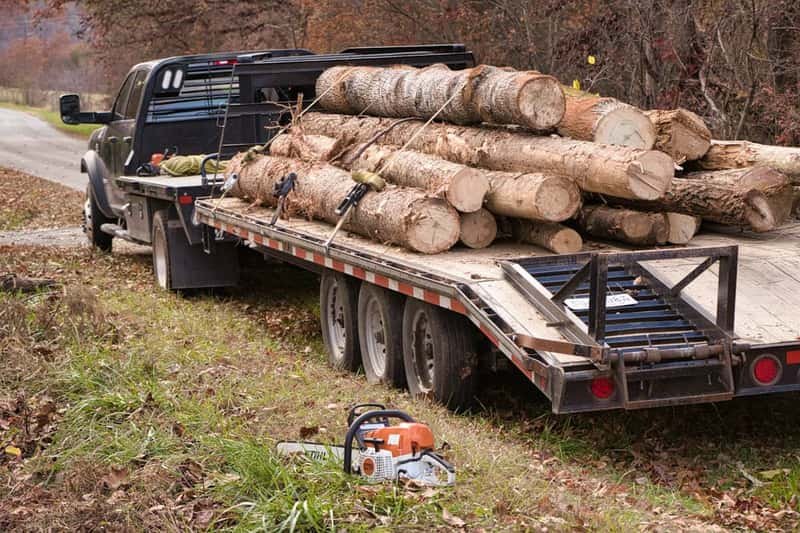
Hotshot freight, sometimes sold as expedited flatbed, is the small end of open-deck trucking: a Class 3 to Class 5 pickup (think F-350/3500 to F-550/5500, usually a dually) pulling a gooseneck flatbed with about 40 feet of deck. It exists for freight that is too light or too urgent to justify a tractor and a 48-foot trailer: a pair of motors for a line that is down, a skid steer headed to a jobsite, a bundle of pipe, a crated panel. The truck that loads it delivers it, with no terminal and no transfer.
This page is written for the person buying that move. It covers the deck itself, the weight line that decides which truck can legally take your load, what published sources say shippers pay in 2026, how far one driver can legally go in a day, securement and permits, and how to verify a carrier in five minutes. Nationwide hotshot lanes and partial (shared-deck) hotshot each have their own page.
What a hotshot is, and the deck you are buying
The trailer matters more than the truck. The standard hotshot deck is a 40-foot gooseneck: 8 ft 6 in (102 in) wide, roughly 3 ft off the ground, with tandem axles a few feet from the rear and, on most units, a 5-foot dovetail with fold-up ramps for drive-on equipment. The gooseneck hitch sits in the truck bed over the rear axle, which is why these trailers tow more stably than a bumper-pull and can legally carry more.
Three practical consequences follow from that layout:
- Long pieces are fine, heavy pieces have a home. A 36-foot bundle of pipe lies along the deck. A single 6,000 lb crate goes in the prime zone, not on the dovetail.
- Forklift from the side is easy; crane from above is easy. There is no roof. Dock-height loading is not: the deck is about 3 ft high, below a standard 48-inch dock.
- Drive-on works. Compact equipment rolls up the ramps onto the dovetail and forward into the prime zone; see what that costs on our cost to ship a skid steer page.
Typical hotshot freight
- Electrical equipment: motors, switchgear sections, transformers, panels and drives (our motors and switchgear guide covers crating and lift points).
- Machine parts: replacement components for a line that is down or about to be.
- Pipe, valves and fittings: short bundles, spools and skids.
- Compact equipment: skid steers, mini excavators, generators, pumps and compressors.
- Jobsite partials: materials that cannot wait for the next consolidated delivery.
- Oilfield and energy parts: wellsite components, tooling and replacement parts.
What fits: weight, the CDL line, and when it is a flatbed job
Space rarely limits a hotshot. Weight does, and the limit comes from a federal definition rather than from the trailer's strength. Under 49 CFR 383.5, a combination is a Group A commercial motor vehicle when its gross combination weight rating (GCWR) or actual gross combination weight is 26,001 lb or more and the towed unit is rated over 10,000 lb; 49 CFR 383.91 is the section that assigns that group to a Class A CDL. For most pickups the GCWR is the sum of the truck's and the trailer's GVWR plates, because few pickups print a GCWR on the certification label.
That single line splits hotshot into two kinds of truck:
| Setup | How it is plated | Freight it can take | Driver |
|---|---|---|---|
| Non-CDL hotshot | Truck GVWR + trailer GVWR of 26,000 lb or less (for example 11,500 + 14,000, or 14,000 + 12,000) | Planning range of roughly 8,000–10,000 lb. On paper, 26,000 lb less the truck and the empty trailer (often 14,000–17,000 lb together) is 9,000–12,000 lb, but each plate has its own ceiling, so real payloads run lower. Use 8,000 lb as the conservative line and ask the carrier for the plated payload. | Regular license. Still a regulated commercial vehicle in interstate commerce at 10,001 lb GVWR/GCWR and up (49 CFR 390.5): USDOT number, medical card, hours-of-service rules. |
| CDL hotshot | Same truck or a Class 5, trailer plated 20,000–25,900 lb; GCWR well over 26,001 lb | Above the non-CDL range, up to about 16,000 lb on a 40 ft deck (Beardown Logistics, Feb 2026, cites 16,500 lb on a heavier combination) | Class A CDL holder, with the full CDL rule set (testing, medical, logs) |
| Full flatbed or step-deck | Tractor and 48' or 53' trailer, 80,000 lb gross | Up to about 45,000–48,000 lb, pieces longer than 40 ft, or several heavy pieces that would fill a hotshot deck | Class A CDL |
Two ranges to carry in your head: about 8,000–10,000 lb is the non-CDL planning range (above it, plan on a CDL setup; read it as a cut-off, not as a capacity to load up to), and about 16,000 lb or 40 ft is where a load stops being a hotshot load at all. Freight wider than 102 in or needing a tarp over something 10 ft tall also pushes toward a flatbed or step-deck. The hotshot vs. flatbed vs. dry van guide and the trailer selector walk through the choice.
For palletized freight, floor space and weight run out at different points: a 40 ft deck fits 20 standard pallets straight, but a non-CDL unit carries that many only if each weighs under about 400 lb. The pallet and linear-feet calculator has a 40 ft hotshot preset that does the arithmetic for your pallet count and weight.
What shippers typically pay: hot shot freight rates and hotshot shipping cost
Hotshot pricing is quoted per loaded mile for longer runs and as a flat day rate for short ones. The ranges below are what named, dated, public sources said when we opened them in October 2026. Note the last column: most published figures describe carrier pay, what the truck receives, not the all-in price a shipper sees, which adds accessorials and, when an intermediary is involved, its margin.
| Source and date | What it reports | Describes |
|---|---|---|
| FreightWaves, May 18, 2026 | Most hotshot loads pay $1.50–$2.00 per mile; urgent or complex loads reach about $3.00; simple runs in competitive markets come in closer to $1.00. | Carrier pay (what the load pays the truck) |
| FreightRun, 2026 benchmarks | Standard utility or flatbed trailer (to 7,000 lb) $1.50–$2.25; gooseneck (to 16,500 lb) $2.00–$3.00; step deck (to 20,000 lb) $2.50–$3.50 per mile. | Shipper-facing benchmark on a freight marketplace's quote page |
These are the two sources the worked example below uses. The other dated sources (O Trucking, Truckstop, Sims Global Solutions) and the short-run minimums are laid out once, with their dates, in Hotshot rates explained.
Read across the rows and the sources fall into two bands. The driver-facing pages describe carrier pay of roughly $1.50–$2.00 per mile for ordinary loads, and the one shipper-facing page in the table (FreightRun, 2026) lists $2.00–$3.00 per mile for a gooseneck. The same sources put urgent, tarped, oversize or remote moves above those bands, and a flat minimum on runs below about 150–200 miles. These are the sources' figures, not Averstone Logistics prices. For week-to-week direction, DAT's free Trendlines page tracks national flatbed spot rates; we don't republish its figures. Fuel is the carrier's biggest variable cost: the EIA weekly survey put U.S. on-highway diesel at $6.276 per gallon for the week of October 19, 2026, and the figures above move with it. Hotshot rates explained carries the full table of published rates and the regional diesel snapshot.
The charges behind the rate
- Minimum charge. A truck day is the unit of sale. Under roughly 150–200 miles the price is a flat figure rather than a per-mile rate, because the driver's deadhead, loading time and return are the same whether you move 40 miles or 140.
- Deadhead. Empty miles to reach your pickup, and after delivery if no return load is likely. Hotshot units are scattered, so the nearest truck may be 50–150 miles out. FreightRun lists this as a quote factor; some carriers show it as a line, most fold it into the rate.
- TONU (truck ordered, not used). A flat fee when a load cancels after dispatch or after the truck arrives. It should be a stated amount with a stated trigger.
- Detention. Free time at pickup and delivery (commonly one to two hours), then an hourly charge. Hotshot drivers live on turns, so waiting costs them a disproportionate share of the day.
- Tarping, permits, layover. Each is a separate line when it applies.
| Raises the price | Lowers the price |
|---|---|
| Same-day or weekend pickup, after-hours delivery | A pickup window of a day or two |
| Tarping, oversize permits, escorts | Crated or wrapped freight that needs no tarp |
| Remote origin or destination with no return freight | Dense lanes where the truck can reload |
| Weight near the truck's ceiling (fewer trucks qualify) | Light freight any hotshot can take |
| No forklift at one end, driver has to wait for a crane | Forklift and a contact at both ends |
| Rising diesel | Sharing a deck already heading your way (a partial) |
Worked example (illustrative arithmetic on published ranges, not a price)
Two crated electric motors, 3,200 lb total, each crate 72 × 48 × 48 in, forklift at both ends, no tarp needed, Charlotte, NC to Richmond, VA: about 290 loaded miles, with the nearest available truck 45 miles from the shipper. The table multiplies two cited per-mile ranges by those miles; it prices nothing, and Averstone Logistics does not quote shipments.
| Step | Figure |
|---|---|
| Carrier pay, per FreightWaves (May 18, 2026): $1.50–$2.00/mi × 290 mi | $435–$580 to the truck |
| Shipper-facing benchmark, per FreightRun (2026): gooseneck $2.00–$3.00/mi × 290 mi | $580–$870 |
| Fuel: 335 total miles at an assumed 9 mpg towing = 37.2 gal × $6.276 (EIA, week of October 19, 2026) | About $234 of diesel before the driver earns anything |
| Timing: 45 mi deadhead + 290 mi, about 7 hours of driving inside the 11-hour limit | Loaded by 1 pm, delivered the same evening if the receiver takes freight after 8 pm; otherwise first thing next morning |
Read the two cited bands side by side: the carrier-pay band tops out at $580, where the shipper-facing band begins and then runs to $870. Why the two kinds of figure differ (accessorials, deadhead and, when an intermediary books the truck, its margin) is covered in the carrier pay versus shipper price discussion above. Neither band includes the free time, detention rate or TONU a written price should state. A price far below the carrier-pay floor is a warning sign: diesel alone is about $234 on this lane, so a price near that figure points to a truck that may not show, or a partial sold as an exclusive.
Partial and shared-deck hotshot
If your freight uses 12 feet of a 40-foot deck, you can pay for 12 feet. A partial hotshot puts two or three shippers' loads on one deck, each paying by the space and weight used. It is the cheapest way to move a pallet or two of urgent open-deck freight, at the cost of a stop or two and some dependence on the other shippers' schedules. How partials are priced, how to protect your delivery date and when an exclusive truck is worth the difference are on the partial hotshot page.
Same-day and next-day: what one driver can legally do
Hotshot is sold on speed, so the rules that cap speed matter. Under 49 CFR 395.3, a driver may not drive without first taking 10 consecutive hours off duty (395.3(a)(1)); may not drive after 14 consecutive hours after coming on duty following those 10 hours off (395.3(a)(2)); may drive a total of 11 hours within that 14-hour period (395.3(a)(3)(i)); and may not drive once more than 8 hours of driving time have passed without at least a consecutive 30-minute interruption in driving status (395.3(a)(3)(ii)), which on-duty time not driving can satisfy. These limits apply to a non-CDL hotshot in interstate commerce just as they do to a tractor. The 14-hour clock starts when the driver comes on duty, which may be two hours before your dock.
At a realistic 45–50 mph average driving speed, 11 hours is roughly 500–550 miles of driving at the legal maximum. After the deadhead to reach you, an hour on your dock and the 30-minute break, about 450 loaded miles is the planning figure for one driver in one day, and driving days are miles divided by 450, rounded up (the nationwide transit page applies the same rule by distance band, and the hotshot estimator turns it into days for two ZIP codes). From it, the realistic schedule looks like this (planning assumptions, not a promise):
| Loaded miles | One driver, realistic | Cutoff that makes it work |
|---|---|---|
| Up to ~250 | Same day | Loaded by about noon, with a truck already close by |
| 250–450 | Same day only with an early pickup; otherwise next morning | Loaded by 9–10 am and a receiver open into the evening |
| 451–900 | Two driving days: delivery on day 2 (the driver takes the 10-hour rest en route) | Loaded by early afternoon |
| 901–1,350 | Three driving days: delivery on day 3 | Any pickup time; later pickups push the delivery toward the end of day 3 |
| Over 1,350 | Four or more driving days solo; a team or a full flatbed may suit better | See nationwide hotshot for long-lane planning |
Two things wreck these numbers: a receiver that closes at 3:30 pm, and a 2 pm "ready" that becomes 4 pm. If the freight will not be ready, say so early; a hotshot driver who sits two hours at your dock has lost the afternoon run that made your rate possible.
Tarps, securement and permits
Tarps
A gooseneck has no roof, so weather protection is either your packaging or the driver's tarp. Crated, shrink-wrapped or painted-for-outdoors freight usually needs none. Electrical gear, finished surfaces, bagged product and lumber do. Tarping is a separate line because it takes the driver 30–60 minutes each way and the carrier has to carry the tarps; say "tarp required" in the request so the right truck is dispatched. Common tarp drops are 4, 6 and 8 ft; freight taller than the drop leaves the bottom exposed.
Securement
The federal cargo securement rules, 49 CFR 393.100–136, apply to a gooseneck exactly as they do to a 48-foot flatbed. Two rules do most of the work. First, the combined working load limit of the tiedowns on an article must be at least half the article's weight (393.106(d)). Second, 393.110 sets the minimum count for articles not blocked against forward movement:
| Article | Minimum tiedowns |
|---|---|
| 5 ft or shorter and 1,100 lb or less | 1 |
| 5 ft or shorter and over 1,100 lb | 2 |
| Over 5 ft up to 10 ft, any weight | 2 |
| Over 10 ft | 2, plus 1 for every additional 10 ft or part of 10 ft |
An article blocked against forward movement by a headerboard or bulkhead needs at least one tiedown per 10 ft (393.110(c)). What this means for you: tell the carrier the piece count, lengths and weights, and whether there are forklift pockets, lift points or a skid to strap to. A 2-inch strap carries a working load limit of roughly a third of its break strength, and a 10,000 lb machine can need four chains, not two straps. Drivers who know that before dispatch bring the right gear.
Permits
Federal law sets a maximum width of 102 in (8 ft 6 in) for commercial vehicles on the National Network and sets no federal height limit; states set height limits, most between 13 ft 6 in and 14 ft (FHWA, federal size regulations). In practice: anything wider than 102 in needs a state oversize permit for every state on the route, and with the deck about 3 ft off the ground, freight taller than roughly 10 ft 6 in can hit the 13 ft 6 in states. Permits are per state, take hours to days, and may require daytime-only travel or an escort; they belong in the price a carrier gives you, not in a surprise invoice. A step-deck does not fix an over-height hotshot load: its lower deck sits about 3 ft 6 in off the ground, higher than a gooseneck hotshot deck (about 3 ft). An over-height piece needs a lower deck, such as a lowboy or RGN trailer, whose decks usually sit 18 to 30 inches off the ground (Custom Truck, Nov 21, 2025), or an over-height permit, and that is a different truck from a hotshot.
How to verify any carrier in Motus and SAFER
Hotshot capacity is mostly one- and two-truck businesses, which is fine, but it puts the checking on you. Five minutes on FMCSA's public records covers it, whoever you hire. One change since older guides were written: on May 14, 2026 FMCSA moved registration records into a new system called Motus, and its April 29, 2026 Federal Register notice says it will sunset the former Licensing and Insurance (L&I) system. A law firm's October 14, 2026 client alert (Benesch) reports that the legacy SAFER and L&I pages no longer present current registration information to the public. So authority and insurance come from Motus, and SAFER is for the safety record.
- Get the USDOT number from the carrier, and the MC docket number if they have one. The USDOT number is the reliable key; names repeat.
- Search the Motus public search (type motus.dot.gov yourself; FMCSA warns about look-alike sites) for the USDOT number. It must match exactly. Name searches return every company that starts the same way, so always finish with the number.
- Read the registration record. The USDOT status should read Active. In the operating authority table a for-hire carrier moving freight between states needs Motor Carrier of Property reading Active. Inactive, or a Pending status with a reason such as missing financial responsibility filings, means stop until it is resolved.
- Match the name, address and phone in Motus to the quote, the insurance certificate and the invoice. A different legal name on each is the most common sign of a double-brokered or borrowed authority.
- Open the authority to see the insurance on file. The detail page lists the liability filing: insurer, amount, status and effective and cancellation dates. A filing that is not Active, or a cancellation date before your pickup, is a reason to stop. Cargo insurance is not filed with FMCSA for most carriers, so ask for a certificate of insurance naming the carrier, with a cargo limit at least equal to your freight value, and call the agent on it if the value is high.
- Open the FMCSA SAFER Company Snapshot for the safety record: power units and drivers (one truck is normal for hotshot), the inspection and crash counts for the last 24 months, any out-of-service date, and the safety rating. Most small carriers show no rating, which is not a red flag by itself; a conditional or unsatisfactory rating is.
- Check the truck that arrives. The USDOT number on the door should be the one you looked up.
Motus is new and FMCSA may change its screens; if a field described here has moved, FMCSA's contact center is 1-800-832-5660. Our guide to verifying a car shipper walks through the same Motus screens step by step. Once our own registration is active, the same records will show ours; use them on us too.
What a written hotshot shipping quote should contain
A hotshot price quoted by phone is a guess until it is written down with its conditions. Hold any quote you receive, from anyone, to this list:
- Equipment: non-CDL or CDL hotshot, deck length, and whether the truck is exclusive to your load or a partial.
- The all-in line haul, stating that fuel is included (or the surcharge formula if not).
- Pickup window and delivery commitment, with the receiver's hours acknowledged.
- Conditional charges, each with amount and trigger: detention after how much free time, TONU if cancelled after what point, layover, tarping, permits, redelivery.
- Who loads and unloads, and with what; whether the driver is expected to help.
- Securement and protection: number of straps or chains planned, tarp yes or no.
- The carrier's legal name and USDOT number (so you can run the check above) and the cargo insurance limit.
- Validity: how long the price holds. Hotshot spot prices move with diesel and with how many trucks are near you that day.
The Open-Deck Load Prep Sheet below gathers everything a carrier needs to price your freight the first time. Or tell us about your freight now and we will contact you the day we open.
What it costs to ship it: guides by equipment
Each guide below turns the same sourced hotshot and flatbed ranges into a planning range for one kind of freight, with its weights, securement and what raises the price. Run your own ZIP codes in the hotshot estimator and read hotshot rates explained for how the number is built.
- Cost to ship a skid steer: compact loaders and the four-chain tie-down rule.
- Cost to ship a mini excavator: machine classes, weights and when it outgrows a hotshot deck.
- Cost to ship a generator: skid weights by kW, enclosures and lift points.
- Cost to ship motors and switchgear: crated sections on a partial or full deck.
Where this fits
Hotshot and flatbed freight nationwide (lower 48). Dry van truckload across North Carolina, South Carolina, Georgia, Virginia, Florida, Alabama and Tennessee. USA only — no cross-border, no drayage, no rail, no temperature-controlled freight.