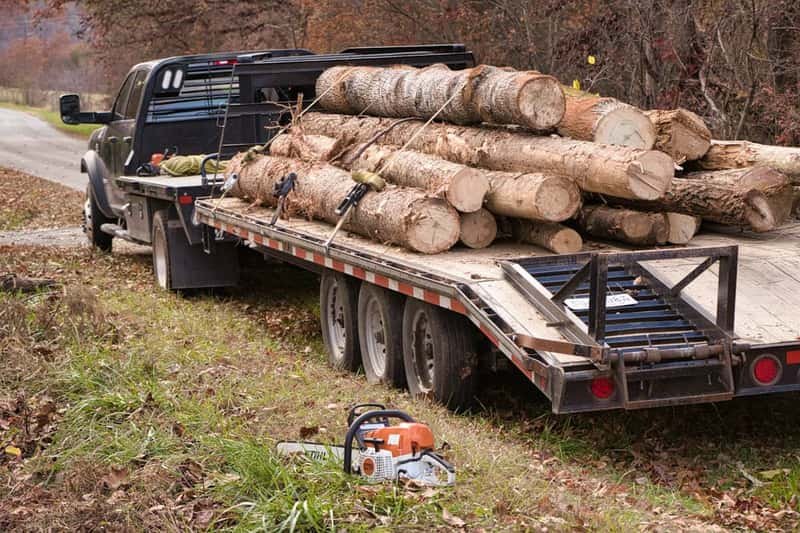
What a hotshot partial is
A standard hotshot move is exclusive: one shipper, one 40-foot gooseneck deck, pickup to delivery with no stops. A partial keeps the same truck and the same direct handling but shares the deck. Your freight is loaded alongside one or two other shipments headed the same way, and the operator runs the stops in sequence: load A, load B, deliver B, deliver A. Nothing is handed to another truck or cross-docked at a terminal, which is the line between a hotshot partial and LTL.
The deck is the constraint. A typical 40-foot hotshot gooseneck is 102 inches wide. PJ Trailers' spec page for its LD model (opened October 2026) lists a 102-inch deck, a 25,000 lb standard GVWR and a 16,770 lb payload at 40 feet; a non-CDL setup carries far less than that once the truck and trailer are counted, as the main hotshot page explains. Two standard 48 × 40 inch pallets fit side by side across that width, so a row of two non-stackable pallets uses about four linear feet. Six pallets is three rows: twelve feet, under a third of the deck. That slot is what a partial is built around. To see the linear feet your own pallets take on a 40-foot deck, and whether weight or floor runs out first, use the pallet and linear-feet calculator.
When a partial makes sense
- Size. One to six pallets, or a single crate or machine under about 4,000 lb that fits in a 4 to 12 foot slot. C.H. Robinson's blog post on hotshot (April 6, 2026) puts the ideal hotshot load under 10,000 lb and 40 feet or shorter, with a ceiling near 17,000 lb. A partial lives at the light end of that so there is room, and payload, left for someone else.
- Timing. A pickup window of a day or two, and a delivery date that can absorb one more. The operator needs that slack to pair your freight with the other load.
- Lane. A corridor with steady open-deck flow in your direction, so a pairing is realistic. Plant-to-plant moves between Southeastern industrial hubs, and anything toward a port or a major metro, pair more easily than a rural-to-rural run.
- Freight that tolerates company. Crated or skidded, weather-tolerant or tarpable, and not easily damaged by a forklift working nearby at another stop.
How partial pricing differs from a full deck
An exclusive hotshot is priced per loaded mile for the truck, and the shipper pays for the whole deck whether 4 feet or 40 are used. The dated per-mile figures that public sources publish, including O Trucking's Hotshot Rates Per Mile 2026 (updated October 4, 2026), are collected once in Hotshot rates explained; most are carrier-pay figures written for owner-operators, not shipper prices. That guide also notes that many broker loads are quoted all-in with fuel bundled while some direct and contract loads add a separate fuel surcharge, and a shipper should ask the same question of any price received. DAT's Trendlines page publishes a weekly snapshot of national average flatbed spot rates if you want to see which way the market is moving; the figures are DAT's and are not reproduced here.
A partial is priced as a share of that truck: by the linear feet you occupy, or per piece or per pallet for small, regular shipments, plus the cost of your stop. Two things make the share larger than your share of the deck:
- Fixed costs do not split. Fuel, the driver's day and the stop time are the same whether the operator carries your 4-foot crate alone or with 30 feet of pallets. For a sense of scale, EIA's U.S. average on-highway diesel price is $6.276 a gallon for the week of October 19, 2026 ($5.740 in the Lower Atlantic states in EIA's regional table for the week of October 19, 2026). At an illustrative 9 miles per gallon loaded, a 250-mile run burns about 28 gallons: roughly $159 at the Lower Atlantic price, or about $174 at the U.S. average.
- The operator carries the pairing risk. If no companion load appears, the truck either runs your freight alone at the partial price or waits. Most operators price partials with a minimum, a floor they will roll for regardless of how little deck you use.
The practical result: a partial's share of the price is usually larger than its share of the deck. In the illustrative example below, a crate on 10 percent of the deck is priced at about 35 percent of the exclusive price for the same lane; the gap is the stop and the pairing risk, and the figure is made up to show the mechanics, not a market rate. Where the lane is busy and the operator already has the other freight booked, the share falls; where you are the first piece on an empty deck, it rises toward the exclusive price, and at that point booking the whole deck buys certainty for little extra.
| Exclusive hotshot | Hotshot partial | |
|---|---|---|
| Pricing basis | Per loaded mile for the whole truck | Share of the deck (linear feet or per piece) plus the stop, above a minimum |
| What you pay for | All 40 feet, used or not | Your footprint, your stop, and a share of fuel and the driver's day |
| Pickup window | Your date | One to two days, so the operator can pair the freight |
| Stops before yours | None | One or two |
| Transit | Direct; distance and driving hours only | Direct route plus the other addresses; add a day of slack |
| Best for | Fixed dates, fragile, high-value, oversize, heavy single pieces | 1 to 6 pallets or one crate under about 4,000 lb with flexible timing |
Transit: what the extra stops really cost
Three things stretch a partial's timeline, and none of them is distance.
- The pairing wait. The operator may hold your pickup a day so the other shipment is ready at the same time. This is the one to two days of slack a partial asks for, and it comes before the truck has moved a mile.
- Stop time. Each loading or unloading stop takes 30 to 90 minutes when the dock or forklift is ready, and longer when it is not. Your freight also sits on the deck while the other shipper's pallets come off, which is why fragile freight is a poor fit.
- Hours of service. A solo driver may drive 11 hours within the 14 consecutive hours after coming on duty, and may not drive once more than 8 hours of driving time have passed without a 30-minute interruption (49 CFR 395.3). For planning, this site counts about 450 loaded miles per solo driver day (see nationwide hotshot). Two extra stops eat one to three hours of the 14-hour window, so a delivery that would have landed at 4 pm on an exclusive move can slip to the next morning on a partial.
Order on the deck follows weight and unloading sequence. Heavier pieces sit over or just ahead of the trailer axles, and the freight coming off first is placed where a forklift can reach it without disturbing the rest. Because an open deck is loaded from the side, that order is less rigid than in a van, but it still means your piece's position is decided by what else is on board.
What to prepare
A partial is priced and planned on paper before the truck arrives, because the operator has to know whether your freight fits beside someone else's. Have these ready:
- Dimensions as shipped. Length, width and height of each piece including the pallet or skid, plus any overhang. A 48 × 48 × 52 inch crate on a 4-inch skid is 56 inches tall, not 52.
- Weight per piece and in total. Actual scale weight, not the catalogue weight of the machine inside.
- Stackable or not. Can anything sit on your freight? Can your freight sit on anything? What is the maximum stack height? Mark non-stackable freight on the paperwork.
- Tarping. Say up front if the freight needs weather protection. On a shared deck the tarp has to be fitted around the neighbours, which takes time and is usually priced as an accessorial.
- Loading equipment at both ends. Forklift and its capacity, crane, or overhead hoist; dock height or ground level; where the lift points are; and who is on site to operate it.
- Windows and site rules. Ready date and time, latest acceptable delivery, receiving hours, check-in requirements and whether the site can take a 40-foot gooseneck.
- Paperwork and a photo. A bill of lading with piece count, weight and reference numbers, and a phone photo of the piece. The photo does more for securement planning than any description.
Our free Open-Deck Load Prep Sheet below covers every line above. If you ship palletized freight too, the Quote-Ready Checklist is the general version.
Tie-downs: why your dimensions matter to the operator
Each shipment on a shared deck is secured independently under 49 CFR Part 393, Subpart I. Section 393.110(b) sets the minimum number of tiedowns for an article that is not blocked against forward movement: one for a piece 5 ft or shorter weighing 1,100 lb or less; two for a piece 5 ft or shorter weighing more than 1,100 lb, or for anything over 5 ft up to 10 ft; and two plus one more for each additional 10 ft, or fraction of 10 ft, beyond that. (An article braced against a headerboard or other secured cargo needs at least one tiedown per 10 ft under 393.110(c), which is why position on the deck matters.) Section 393.106(d) requires the aggregate working load limit of the tiedowns to be at least half the weight of the cargo they secure. A 2,800 lb crate therefore needs two tiedowns with a combined working load limit of at least 1,400 lb. The operator wants those numbers before arriving so straps, chains and anchor points are planned around the freight already on the deck. Pallet counts and weights go into the pallet calculator; dimensions, lift points and securement notes go on the prep sheet.
When a partial is the wrong choice
A partial trades certainty for price. These are the cases where the trade goes against you, and an exclusive hotshot or a full flatbed is the better call.
Book the whole deck when
- Fragile. Forklifts work alongside your freight at other stops, and straps are re-tensioned after each one. Switchgear, glass, finished panels and precision assemblies belong on an exclusive move; see shipping motors and switchgear.
- High-value. More sites, more people and more hours around your freight. Ask how cargo coverage applies per shipment on a shared deck before you book one.
- Time-critical. The pairing wait and the extra stops cancel the speed advantage that made hotshot attractive. A line-down part goes exclusive.
- Oversize or permitted. Anything over 8 ft 6 in wide, over legal height, or needing a permit takes the whole truck; permits and any escort cover the vehicle, not a slot on it.
- Heavy single pieces. A 6,000 lb unit uses most of a non-CDL rig's payload and dictates axle placement, leaving little room to pair. Priced per piece, it is often no cheaper as a partial.
- Hazardous materials. Segregation and placarding rules apply to the whole vehicle and are reviewed case by case once we open.
A partial fits when
- One to six pallets, or one crate or machine under about 4,000 lb
- Nothing wider than the deck and nothing that needs a permit
- Crated, skidded or otherwise able to take a strap and a neighbour
- Pickup can float a day or two; delivery can absorb one more
- Along a corridor with regular open-deck traffic in your direction
- Replacement stock, scheduled maintenance parts, jobsite material that is not on the critical path
Typical partial freight: pumps, compressors, small transformers, pipe and valve bundles, racking, fixtures, compact equipment and crated machine components. Our industrial and electrical and steel, pipe and metals pages cover the industries these come from.
Worked example
Illustrative only, not a quote: one crated gearbox, Charlotte, NC to Savannah, GA
A 2,800 lb gearbox, crated to 48 × 48 × 52 inches on a 48 × 48 inch skid, ready Tuesday and needed by Friday. About 250 road miles. The numbers below are made up to show the mechanics; every price is illustrative.
| Exclusive hotshot | Hotshot partial | |
|---|---|---|
| Deck used | 4 ft of 40 (10 percent), but you pay for all 40 | 4 ft of 40, shared with four pallets going Greensboro to Jacksonville |
| Pricing basis | 250 loaded miles at an illustrative $3.00 all-in, fuel and margin included: $750 | Share of deck plus the stop, at an illustrative 35 percent of the exclusive price: $262.50, above the operator's minimum |
| Fuel inside that price | About 28 gallons at EIA's Lower Atlantic average of $5.740 per gallon (regional table, week of October 19, 2026), roughly $159. The same gallons burn either way, which is why 10 percent of the deck is never 10 percent of the price. | |
| Pickup | Tuesday, at your time | Window Tuesday to Wednesday; actual pickup Wednesday 1 pm after the pallets load in Greensboro |
| Delivery | Tuesday evening: about 5 hours of driving, well inside the 11-hour limit | Thursday 9 am as the first stop off; the pallets ride on to Jacksonville |
| Tie-downs (49 CFR 393.110) | Crate is 5 ft or shorter and over 1,100 lb: minimum two tiedowns, with an aggregate working load limit of at least 1,400 lb (half of 2,800) under 49 CFR 393.106(d) | |
The difference is $487.50, bought with a two-day pickup window and a Thursday delivery instead of Tuesday. If a line is down waiting for the gearbox, the exclusive truck is the right answer. If it is a scheduled replacement for next week, the partial is. Neither number is a market rate: both are invented for the illustration, and the dated public figures, labelled carrier pay or shipper price, are in Hotshot rates explained.
Not sure which side of the line your freight falls on? Tell us about your freight, including the dimensions and whether the date can float, and we will talk through both options when we contact you. We answer every message within 30 minutes, Mon–Fri 8am–5pm ET, and within 6–12 hours at other times.
Hotshot and flatbed freight nationwide (lower 48). Dry van truckload across North Carolina, South Carolina, Georgia, Virginia, Florida, Alabama and Tennessee. USA only — no cross-border, no drayage, no rail, no temperature-controlled freight.