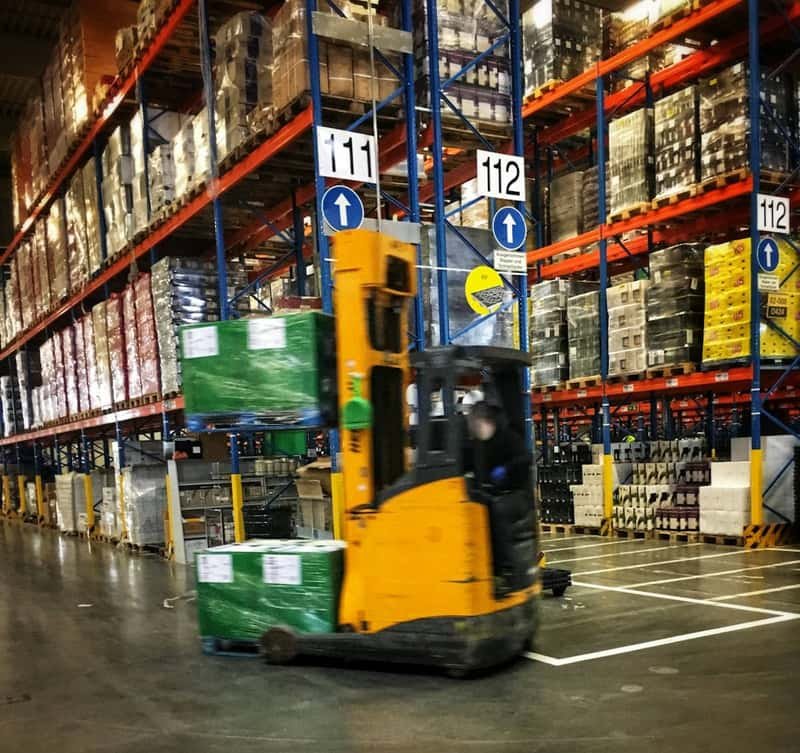
The freight is easy. The receiving dock is not.
Consumer packaged goods — household staples, personal care, paper goods, packaged snacks, school and office supplies — are some of the simplest freight to put on a trailer. Boxed, palletized, stackable more often than not, and nearly always a 53-foot dry van. The difficulty is at the other end. A retail distribution center or wholesaler receives hundreds of trucks a day on a fixed schedule, and it holds vendors to its own rules about when, how and with what paperwork freight arrives.
Most CPG shipments move one of three ways:
- Plant or co-packer to retail DC — the vendor ships against a purchase order into a scheduled appointment.
- Plant to wholesaler or distributor — usually a little more flexible on timing, but still PO-driven.
- Plant to your own or a third-party warehouse — replenishment and inventory builds, often on a recurring lane.
PO and appointment compliance
At a retail DC, the delivery appointment is tied to specific purchase orders. If the PO number on the bill of lading doesn't match what the receiver has scheduled, or the truck arrives with a different pallet count than the PO expects, the load can be refused or worked late. Before a CPG load is dispatched, a good plan confirms:
- Every PO number and the pallet and case count for each
- Who books the delivery appointment — the vendor, the carrier or a consolidator — and how (portal, email or phone)
- The appointment window and the receiver's late-arrival policy
- Delivery reference numbers that need to appear on the bill of lading
- Whether the receiver requires a live unload or allows a drop
Pallet specs and load quality
Receivers often publish pallet requirements in their routing guides: pallet type and grade, maximum height, no overhang, stretch-wrap and corner-board expectations, and labeling on specific faces of the pallet. Damaged or non-conforming pallets can be refused or reworked at the vendor's expense. These rules vary by retailer and change over time, so the plan should work from the receiver's current guide for your shipment rather than assumptions — and pallet height and stackability should be settled up front because they decide how many positions the load uses.
OTIF fines, in plain terms
Many large retailers measure vendors on on-time-in-full: did the full order arrive inside the scheduled window? Some charge a percentage of the order value or a flat fee for misses, both early and late. Transportation is one input; order accuracy and readiness are the others. The freight side's job is realistic pickup windows, carriers who understand appointment times are fixed, and updates early enough that a delay can be rescheduled instead of simply missed.
The targets themselves move. Logistics Management reported on February 29, 2024 that Walmart had cut its supplier requirement from the 98% on-time-and-in-full bar it set in 2020 to 90% on time and 95% in full, effective February 1 of that year. That is one retailer's published change, not a rule for every receiver, which is exactly why the plan should come from the receiver's current routing guide for your shipment.
Seasonality and promotional spikes
CPG volume is lumpy. Back-to-school, holiday builds, summer beverage season and one-off promotions can double a lane's weekly loads for a few weeks. Capacity in many markets also tightens at the same times. The fix is boring but it works: share the forecast early, even if it's rough, so the plan includes trucks before the spike rather than a scramble the week product ships. For steady weekly freight, see our recurring lanes page.
Partial vs. full truckload
| Option | Usually the better choice for | Watch for |
|---|---|---|
| Full truckload | Orders over roughly 12–14 pallets (about 28 linear feet) or 15,000–20,000 lbs, up to a full van; time-sensitive DC appointments | Paying for space you don't use on very light loads |
| Volume partial | About 6–14 pallets (roughly 12–28 linear feet of trailer floor) with flexible timing | Extra stop, shared trailer, appointment alignment |
Worked example (illustrative): a 10-pallet order
Ten 48 × 40 in pallets of paper goods, 1,200 lb each, not stackable. Two pallets fit side by side across the trailer, so 10 pallets make 5 rows of about 4 feet: 20 linear feet. The weight is 10 × 1,200 = 12,000 lb. Against the thresholds in the pallet calculator (under 12 linear feet is standard LTL, 12 to 28 is partial or volume, and a full truckload is the norm above 28 linear feet, roughly 12–14 pallets, or 15,000–20,000 lb), this order sits in volume-partial territory on both measures. Add four pallets of the same weight and it reaches 14 pallets, 28 linear feet and 16,800 lb: the top of the partial range on floor space and inside the weight band (15,000–20,000 lb) where a full truckload becomes the norm, so a full van is then usually the better value. The numbers are illustrative; the thresholds are the calculator's rules of thumb, not a quote.
How much a full van holds: a 53-foot dry van takes about 26 standard pallets single-stacked, whether they are 48 × 40 in or 48 × 48 in (two across, thirteen deep), and up to 30 of the 48 × 40 size turned sideways. Stackable pallets roughly 4 ft tall or less can go two high, up to about 52, as long as the total stays under the van's payload of roughly 42,000–45,000 lbs. The pallet calculator runs the numbers for your pallet size and weight.
Planned coverage once we open: Hotshot and flatbed freight nationwide (lower 48). Dry van truckload across North Carolina, South Carolina, Georgia, Virginia, Florida, Alabama and Tennessee. USA only — no cross-border, no drayage, no rail, no temperature-controlled freight.
For the full receiving checklist, read our Retail DC Delivery Guide, or tell us about your freight and we'll contact you the day we open.