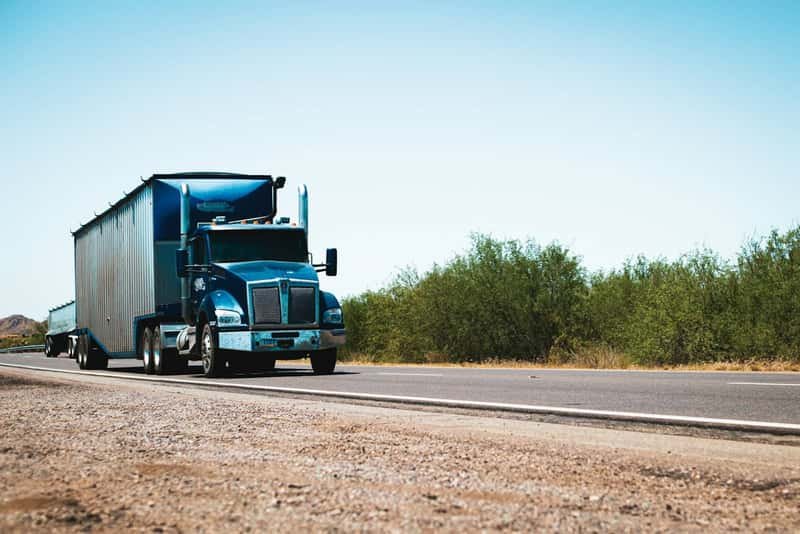
Scope: the 48 contiguous states, and nothing past them
Hotshot and flatbed freight nationwide (lower 48). Dry van truckload across North Carolina, South Carolina, Georgia, Virginia, Florida, Alabama and Tennessee. USA only — no cross-border, no drayage, no rail, no temperature-controlled freight.
In practice that means a hotshot load can start at a dock in the Southeast and deliver to any jobsite, plant or yard in the lower 48. Alaska and Hawaii are out, because both involve a water or air leg that a gooseneck trailer cannot make. Canada and Mexico are out, because cross-border freight needs customs filings and carrier authority that this service does not cover. If your freight is bound for a port to be loaded on a vessel, the move to the port gate is in scope; the port handling and the ocean leg are not.
If you have not read the hotshot overview, start there: it covers what a hotshot rig is, the loads that fit, and the difference between CDL and non-CDL setups. This page is about distance.
How transit time is estimated
A hotshot is almost always one driver, and one driver is limited by federal hours-of-service rules. The rules that matter for planning are in 49 CFR 395.3:
- 10 consecutive hours off duty before driving (395.3(a)(1)).
- A 14-hour window. A driver may not drive after 14 consecutive hours after coming on duty following those 10 hours off, whether or not the driving hours were used (395.3(a)(2)). Time spent waiting at your dock counts against this window.
- 11 hours of driving in total during that 14-hour period (395.3(a)(3)(i)).
- A 30-minute break. Driving is not permitted once more than 8 hours of driving time have passed without at least a consecutive 30-minute interruption in driving status; off-duty, sleeper-berth or on-duty-not-driving time can satisfy it (395.3(a)(3)(ii)).
- 60 hours on duty in 7 consecutive days for a carrier that does not operate every day, or 70 hours in 8 consecutive days for one that does (395.3(b)). A period of 34 or more consecutive hours off duty ends a 7- or 8-day period (395.3(c)). This is the clock that bites on 2,000-mile runs.
Eleven hours sounds like 600 miles or more. It is not. Average over-the-road speed with fuel stops, scale houses, construction zones and city traffic at both ends lands closer to 45–50 mph, which is roughly 500–550 miles of driving at the legal maximum, before any dock time. Take out the deadhead, the break and an hour or two at your dock, and the planning figure is about 450 loaded miles per solo driver day, the same figure the hotshot overview uses. Two more things get added on top of the driving math:
- Facility time. Getting to your dock, checking in, loading and securing a hotshot load typically takes one to two hours, and it all comes out of day one's 14-hour window. A midday pickup turns day one into a half day.
- Appointment time. If the receiver takes freight only between 7 a.m. and 2 p.m., a truck that could physically arrive at 4 p.m. delivers the next morning. The transit estimate has to be built backward from the appointment, not forward from the pickup.
Transit expectations from the Southeast
The table below applies the planning rule to runs that start at common Southeast origins. Mileages are approximate interstate miles for orientation; use your own routing tool for the actual lane. Every figure is a planning estimate for a solo driver with a legal-dimension load, not a commitment.
| Distance band | Planning transit | Example runs from Southeast origins (approx. miles) | What usually decides it |
|---|---|---|---|
| Up to 450 mi | Same day or next morning | Charlotte → Atlanta (~245), Savannah → Jacksonville (~140), Richmond → Charlotte (~290), Nashville → Memphis (~210), Atlanta → Nashville (~250), Jacksonville → Atlanta (~345) | Pickup time, and whether the receiver is still open when the truck arrives. Up to about 250 miles is same day with a noon load; 250 to 450 needs an early pickup. |
| 451–900 mi | 2 days | Charlotte → Chicago (~760), Atlanta → Houston (~790), Nashville → Dallas (~665), Richmond → Indianapolis (~640), Savannah → Columbus, OH (~700), Jacksonville → Philadelphia (~870) | One overnight. Delivery lands late morning to late afternoon on day 2 depending on where in the band you sit. |
| 901–1,350 mi | 3 days | Charlotte → Dallas (~1,030), Atlanta → Minneapolis (~1,120), Richmond → Kansas City (~1,090), Nashville → Denver (~1,160), Savannah → Oklahoma City (~1,100), Jacksonville → Kansas City (~1,170) | Two overnights. Day 3 is usually a short morning run, so a morning appointment works. |
| 1,351–1,800 mi | 4 days | Charlotte → Denver (~1,560), Nashville → Salt Lake City (~1,650), Savannah → Albuquerque (~1,650), Jacksonville → Denver (~1,750), Richmond → Albuquerque (~1,800) | Three overnights. Weather across the Plains and the Rockies is the usual variable from November to March. |
| 1,801–2,250 mi | 5 days | Atlanta → Phoenix (~1,850) | Four overnights. The 60/70-hour limits start to matter: five driving days is 55 to 65 hours on duty. |
| Over 2,250 mi | 6 or more days | Charlotte → Los Angeles (~2,400), Nashville → Seattle (~2,400), Jacksonville → Los Angeles (~2,400), Atlanta → Seattle (~2,650), Richmond → Los Angeles (~2,650), Savannah → Portland, OR (~2,800; 7 days) | Five or more overnights. A driver who is not fresh may need a 34-hour restart mid-trip (395.3(c)). |
Two reading notes. First, the bands assume the truck leaves your dock early in the day; a 3 p.m. pickup pushes most loads to the top of the band's range, or into the next band. Second, long runs cross time zones going west, which gains an hour or two of receiver time on arrival and loses it coming back east.
Pickup cutoffs, and what "same day" really requires
The cutoff is the latest time the loaded truck has to be rolling for a given delivery promise to be realistic. These are working guidelines, not a schedule:
| Delivery target | Typical distance | Truck needs to be loaded and rolling by |
|---|---|---|
| Same day | Up to ~250 mi (up to ~450 with an early pickup) | About noon for 250 miles, with the receiver open into the early evening; by about 9–10 a.m. for the longer runs |
| Next morning | Up to 450 mi, pickup after midday | Mid-afternoon; the driver stages near the receiver overnight and delivers at opening |
| Day 2 | 451–900 mi | About 3 p.m. on day 1, so day 1 still covers 250–300 miles |
| Day 3 and beyond | 901 mi and up | Cutoff matters less; each extra day is another 450 miles |
"Same day" is the promise people ask for most and the one that depends on the most conditions. It requires all of the following at once:
- An empty truck already within reach. Hotshot capacity is scattered. The truck has to be sitting empty no more than an hour or two from your dock, not finishing a delivery three states away.
- A fresh 14-hour window. A driver who went on duty at 5 a.m. for another load has to stop driving at 7 p.m. no matter how short your run is (395.3(a)(2)).
- A short loading cycle. Forklift ready, freight staged, paperwork done. Every hour at your dock is an hour less of driving.
- A receiver that is open on arrival. Many yards and plants stop receiving mid-afternoon. A truck that arrives at 6 p.m. to a locked gate is a next-day delivery with a layover attached.
- Legal dimensions. Permit loads in many states are restricted to daylight travel and may be barred on weekends and holidays, which ends any same-day plan.
Our quote-ready checklist lists the details that let anyone check these conditions quickly: ready time, receiving hours, loading equipment and exact dimensions.
What changes the price from one lane to another
Mileage sets the baseline, but five other things move a nationwide hotshot price, sometimes more than the distance does.
1. Deadhead to your origin
A hotshot earns on loaded miles and spends on all of them. If the nearest suitable empty truck is 150 miles from your dock, those 150 miles are priced into your load. Metros with dense industrial activity have trucks nearby; rural plants, mines and remote jobsites usually do not. This is why two loads with identical loaded mileage can differ sharply in price depending on where they start.
2. The backhaul market at the destination
After delivery the driver needs the next load. A destination with plenty of outbound freight lets the carrier price your load on its own; a destination with little outbound freight (resort regions, peninsulas, the northern plains in winter, most remote jobsites) means the empty return leg gets priced into your load too. DAT's free Trendlines page publishes weekly load-to-truck ratios by equipment type and a market-conditions map; hotshot tends to follow the flatbed market, so when flatbed demand is tightening nationally, expect hotshot pricing to firm with it. We link to DAT rather than republishing its figures, which its terms do not allow.
3. Fuel
Diesel is the largest variable cost on a long run, and it varies by region. The U.S. Energy Information Administration's weekly on-highway diesel survey put the national average at $6.276 per gallon for the week of October 19, 2026. In EIA's regional table for the week of October 19, 2026 (a dated snapshot, kept as published), the Lower Atlantic was $5.740, the Gulf Coast $5.903, the West Coast $7.394 and California alone $8.242 (EIA Gasoline and Diesel Fuel Update, retail price including taxes). A westbound load fuels up in cheaper regions early and more expensive ones late; a load into California pays the highest diesel in the country on its final leg, about $2.50 a gallon more than the Lower Atlantic in that snapshot. Most carriers price fuel either as part of the all-in rate or as a separate surcharge tied to the EIA index; either way, ask which. The hotshot rates guide shows the full regional table.
4. Permits
Federal rules set the baseline most states follow on the Interstate system: 80,000 lbs gross vehicle weight, 20,000 lbs on a single axle, 34,000 lbs on a tandem, and a 102-inch (8 ft 6 in) width on the National Network, with no federal height limit and most state limits between 13 ft 6 in and 14 ft (FHWA, Size Regulations report). Anything beyond those figures needs an oversize or overweight permit, and permits are issued state by state, each with its own routing, fees, travel-hour and escort rules; FHWA's report on permitting practices (FHWA-HOP-17-061) inventories how much those rules differ from one state to the next. For a hotshot, width is the usual trigger: a piece wider than 8 ft 6 in turns a two-day legal run into a four-day permitted one, because each state on the route issues its own permit and many restrict permitted loads to daylight hours.
5. Season and weather
Spring planting and summer construction tighten open-deck capacity across the Southeast and Midwest. The weeks around Thanksgiving and Christmas pull drivers home. Winter storms across the Plains, the Rockies and the northern Interstates add a day to western runs with little warning, and Atlantic and Gulf hurricane season (June through November) can close Southeast lanes outright. None of this changes the hours-of-service math; it changes how many trucks are available to do it, and that is what moves the price.
Worked example: Charlotte, NC to Dallas, TX, about 1,030 miles
Illustrative figures for a 6,000-lb crated motor on a standard gooseneck, legal dimensions, one driver. Not a quote.
| Day | What happens | Miles |
|---|---|---|
| Day 1 (Mon) | Driver on duty 7:30 a.m., at the Charlotte dock 8:30, loaded and secured by 10:00. Drives I-85 to Atlanta and I-20 west with the 30-minute break, stops for 10 hours off near Tuscaloosa, AL around 8:00 p.m. | ~450 |
| Day 2 (Tue) | Rolls at 6:30 a.m. after the 10-hour break (395.3(a)(1)). I-20 through Mississippi and Louisiana, stops near Tyler, TX by early evening. | ~470 |
| Day 3 (Wed) | Short final leg into Dallas for a 9:00 a.m. receiving appointment; unloaded by 10:30. | ~110 |
Transit: 3 days, delivered Wednesday morning. The 901–1,350-mile band says 3 days: 1,030 ÷ 450 = 2.3, rounded up to 3 driving days. Even at the legal maximum of 11 driving hours a day, 1,030 miles at 45–50 mph is 21 to 23 hours of driving, which two days cannot hold once a two-hour pickup is counted. Planning it as Wednesday morning is the honest estimate.
Illustrative fuel math: 1,030 loaded miles plus an assumed 120 miles of deadhead to reach the Charlotte dock is 1,150 miles. At an assumed 9 miles per gallon for a loaded pickup-and-gooseneck rig, that is about 127.8 gallons. At the EIA national average of $6.276 for the week of October 19, 2026, fuel alone is roughly $802; priced at the Lower Atlantic and Gulf Coast averages in the October 19, 2026 regional snapshot ($5.740 and $5.903), the regions the truck mostly passes through, closer to $733–$754. That is a carrier cost, not a shipper price, and it is one line in the rate, alongside the driver's three days, insurance, truck and trailer costs and the empty miles to the next load.
What to send so the estimate is real
A transit estimate is only as good as the inputs. To check a nationwide hotshot plan against the rules above, you need:
- Pickup and delivery ZIP codes, and whether either site is a plant, a yard or an open jobsite
- Ready date and the earliest time the freight can be loaded
- Receiving hours, appointment rules and whether weekend delivery is possible
- Dimensions and weight of every piece, including crates and skids, so width and weight stay legal
- Loading and unloading equipment at each end
- Whether the load is urgent enough to justify a dedicated truck, or could share deck space as a partial hotshot
Not sure hotshot is the right equipment for the distance? The hotshot vs. flatbed vs. dry van guide and the trailer selector will get you to an answer, and the free Open-Deck Load Prep Sheet below captures everything a carrier needs on one page. Or tell us about your freight and we will contact you the day our registration is active.